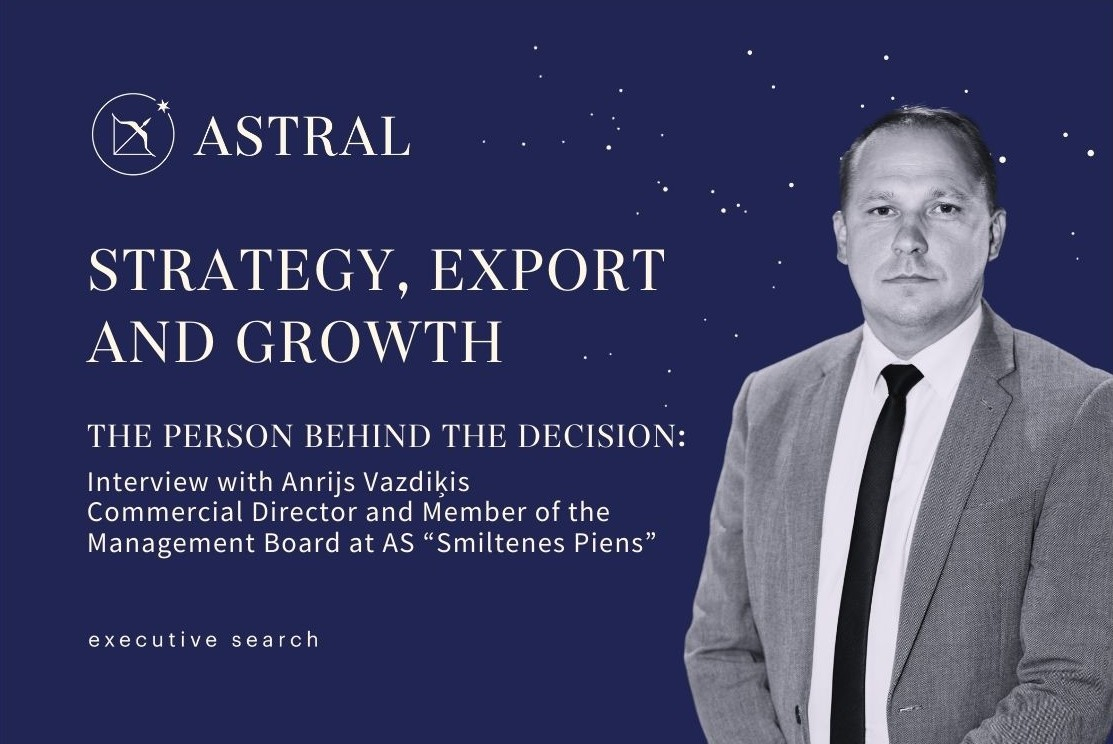
ASTRAL Executive Search Board Member Iluta Gaile met with Anrijs Vazdiķis, Commercial Director and Board Member of AS “Smiltenes piens”, to discuss the company’s development strategy, export opportunities, and growth potential in Latvia’s food industry.
How would you describe yourself and the organization you work for in three words?
I am the Commercial Director and a Board Member at AS “Smiltenes piens”, and I have been working at the company for four years. My professional experience is primarily related to sales — working with clients, partners, and sales teams.
My professional career began in 2001. Throughout my career, I have held various positions that allowed me to gain experience at different levels. I started as a sales representative in the Vidzeme region, later became a Regional Sales Manager, worked with key clients in Latvia, and developed the HoReCa channel. For a little over two years, I led the sales team in Estonia, and afterwards I was responsible for sales management in Latvia for five years.
Gradually developing my skills and taking on increasing responsibility, I have reached my current position as Commercial Director and Board Member at “Smiltenes piens.”
Could you please tell us a bit more about AS “Smiltenes piens”?
What motivated you to move into a leadership role?
I believe it is the desire to achieve ever higher goals and strive for greater results. Early in my career, I had already defined that sales and marketing were closest to me. At the same time, my goal has always been to become a leader at a Latvian brand or manufacturer, not limiting myself only to the role of Commercial Director or Sales Director. I won’t hide that, in the long term, my aim is eventually to become a CEO.
I have always admired large, recognizable Latvian producers and strong brands, such as Laima, Valmiermuižas alus, or in the early days of independence, Aldaris — companies with strong leaders who made their brands even more valuable and well-known. Many young professionals, including myself, aspired to work in such companies.
This shaped my idea of what a good leader should be — someone who cares not only about products and the brand but also about employees, production, the company’s development, and the broader Latvian economy.
Of course, I have always tried to do my work as well as possible — responsibly and with clear objectives. For me, it has never been just about achieving a position, but about attitude and responsibility — toward colleagues and the team, toward the work itself, and ultimately toward the results we aim to achieve. Naturally, such an approach is eventually noticed — an experienced and senior leader recognizes your performance and entrusts you with the next step.
However, I never see it solely as my personal achievement. It is always a team effort — it is the colleagues and the team with whom we have achieved results that have allowed both the company and me to grow professionally.
How would you define a good leader today? Has this definition changed over the past 10 years?
I believe the role of a leader has definitely changed, especially in Latvia. When I was learning to become a leader, the understanding of the position was very different from how we see it today. In the past, leadership was much stricter and more hierarchical. Today, a leader is no longer just someone who pulls the team along, but someone who moves together with the team toward a shared goal and results, knows how to celebrate successes, evaluate obstacles, learn and grow together, continuously strengthening the team as a whole.
A leader is someone who can motivate the team, provide support, and set a clear strategy and objectives to strive for. In my opinion, a good leader must have passion, which creates credibility even when a goal or task seems difficult or even impossible. Much can be achieved when a leader motivates each team member and colleague with their passion and positive conviction. A leader’s confidence can inspire the team and instill belief in others.
The qualities I consider most important are passion, courage, and reliability. I developed these values working in the Scandinavian Orkla group, and I strive to keep them close every day and share them with my team. Passion, in particular, is what helps many people keep moving forward, even in moments when they may not fully believe in themselves.
Your professional journey has taken you from a sales manager role to commercial director and then to a board member position: tell us about your career path, why you are where you are today, and what has been the most challenging part?
After working at Orkla Latvia as Sales Manager for Latvia, my goal was always to grow and develop professionally. In the long term, I wanted to reach an executive or board-level position. I understood that the next logical step after being a Sales Director was a Commercial Director or organizational leader role, overseeing the entire commercial structure.
As a Sales Manager in Latvia, I managed a specific part of the sales structure — regional managers and key account management — but not marketing or logistics. At the Commercial Director or organizational leader level, a much broader structure is managed — sales, marketing, logistics, and other processes. This entails greater responsibility and requires more versatile knowledge.
The next step in my career was H.A.Brieger, which was revitalizing the Dzintars brand in Latvia. There, I had the opportunity to work almost from scratch — developing sales, collaborating with marketing, continuing brand development, and building the product supply chain to ensure availability both in Latvia and for export. This was an incredibly valuable experience — seeing a brand revived from zero and building a completely new commercial structure within the company. It was intense and demanding work over the course of a year, and during that time, the Dzintars brand returned to Latvian store shelves, became stronger, and expanded exports to several countries.
However, my heart belongs to food products. They say love goes through the stomach, and that certainly applies to me. I missed the opportunity to work with well-known Latvian food products and create value-added products that reach people’s tables every day. Several circumstances aligned — Riga had become a bit tiring, and the chance arose to move closer to Vidzeme, Valmiera, and Vaidava. Smiltenes piens offered me the role of Commercial Director, and I accepted the challenge. I was entrusted with managing the entire commercial structure — marketing, logistics, sales, and partially packaging procurement — which provided a very broad scope of work.
One of the most significant benefits was the opportunity to develop export markets, which had been less of a focus in my previous experience. After about a year, the company owner and CEO recognized my contribution and invited me to join the board to participate in strategic decision-making at the company level. Our shared goal is to develop Smiltenes piens into one of the top three dairy processors in Latvia and increase the export share to 30% of total revenue. Clearly defined goals have always been an important motivating factor for me.
What has been the most challenging part of your career path?
The most challenging part was immediately taking responsibility for multiple departments and functions at the same time. For example, logistics — which includes transportation, drivers, warehouses, the supply chain, and coordination with external partners. Managing warehouses, organizing deliveries, and ensuring efficiency is a critical part of the company’s operations.
The biggest challenge was the sheer scope of responsibility. Overseeing several functions simultaneously is demanding. In a regional company, teams are smaller, and many issues have to be handled personally. I worked with both major local clients and export clients. While there is a team, it is smaller than in large corporations, which means that alongside strategic tasks, I also have to be involved in operational processes.
We are still developing the company’s structure and moving toward a more structured, corporate work environment. At the same time, a smaller organization has advantages — decisions can be made quickly, and ideas implemented without complex bureaucratic processes.
Looking back at my career development, what three skills have been critically important for growing from a sales manager to the board level?
Certainly, financial literacy and financial management skills are essential. At the board level, you need to be able to evaluate investments, the company’s development directions, and their financial impact on the business.
Equally important is the ability to analyze the market, understand industry trends, and make strategic decisions. My international experience was particularly helpful in this area — I learned to assess markets, understand competition, and identify growth opportunities. Personally, one of my biggest challenges was the technological and production processes, as my previous experience had been more focused on sales and marketing.
When moving to the next professional level, were there moments when you internally doubted your readiness? What helped you overcome this stage?
Of course, doubts arise at every stage of a career — questioning whether you can handle the tasks and justify the trust placed in you. In those moments, the support of my family was invaluable, especially my wife, with whom I always discussed the most important decisions. I was also fortunate to have colleagues and professional contacts I could consult, discuss ideas with, and seek advice from.
When taking on new positions, we always carefully considered how it would affect our personal life, how much time it would require, and what skills would need to be further developed. It’s important to be aware of your weaknesses and continue learning. Doubts are a normal part of the growth process.
What changes when responsibility increases? Does taking on broader responsibilities also bring greater loneliness in decision-making?
Both yes and no. As responsibility increases, you are required to make final decisions more often, and people look to you for clear direction — strategy, priorities, and development plans. Sometimes this also means making unpopular or risky decisions. However, it is important to involve the team, discuss, and listen to different perspectives. Creating an environment where you are not alone with your decisions is crucial. I regularly consult with colleagues, the owner, and other leaders. Nowadays, information is widely accessible, so there is always an opportunity to study a situation and make a well-informed decision. Much depends on the leader themselves — whether they isolate themselves or actively involve others in decision-making.
In your opinion, what are the most common mistakes leaders make when building their careers?
The dairy industry is highly cyclical and dependent on raw material markets. How does this dynamic influence strategic decisions and export directions?
You need to be ready to react quickly, and we are still learning that. Until 2022, the dairy market was relatively stable, and its cyclical nature was not as pronounced. After 2022, milk prices rose sharply, which is critically important for processors since raw materials make up a large part of the product’s cost. This means that strategy can change depending on the market situation. If information is available and you can analyze it, timely decisions are possible. Of course, there have been cases where decisions were made too early or too late, which can slow down development.
In export markets, long-term strategy is especially important because developing a new market takes time. Ideally, strategy shouldn’t be changed frequently, but in reality, market dynamics sometimes force it. If a producer can create a product with high added value, fluctuations in milk prices have less impact on the final product price. For example, cheese snacks are a high-value product that can be positioned in both the cheese and snack categories. If positioned as a snack, milk price is not the main factor in price setting. This is a matter of strategy — how the product is positioned and in which category it competes.
Export in the food industry is not a simple story. What was the first major challenge you faced when entering foreign markets? How does the export market differ from the local market?
The main difference is brand recognition. In the local market, the brand is very important because consumers are already familiar with it. In export markets, such as Lithuania, Estonia, Scandinavia, or the Middle East, the “Smiltenes piens” brand is not known. This means additional investments in brand development are required, or working with private label products, where the investment is made by the partner or distributor. Often, this is a more effective way to start exporting. Essentially, the distribution structure is similar — there are retail chains and distributors, just like in Latvia. For example, in Latvia these are Rimi, Maxima, Sanitex, etc., while in Germany they include Aldi, Lidl, Rewe, and others.
One of the biggest initial challenges was understanding which products would be appealing for a particular market. Many companies make the mistake of trying to export their entire product portfolio designed for the local market. The correct approach is to identify specific focus products with high added value that can be competitive internationally. Once these focus products are defined, the appropriate clients, channels, and markets can be selected.
When working with partners from different countries, what cultural differences have been the most challenging for you, and how do they affect the negotiation and collaboration process?
That’s a very interesting question. Many Latvian companies start exporting through ethnic markets, meaning their products are sold to local diaspora communities. However, true export involves working with local distributors and retail chains in the target country. For example, in the United States we initially worked with an ethnic distributor, but that is very different from collaborating with major retail chains. A similar situation occurred in Germany. In Europe, business processes are generally fairly similar — meetings, presentations, and proposal preparations. However, in Italy, communication is much more emotional, and partners expect quick and regular updates. In Germany, communication is more structured, formal, and process-oriented.
In Asian countries, such as Korea, Japan, and China, cultural differences are even more pronounced. Partners are very polite and do not openly show emotions, making it harder to read their reactions. In these markets, it’s crucial to be extremely well-prepared and provide detailed information about the product. We prepared product samples in special packaging and used translation tools to make presentations available in the local language. This helped achieve results, and the first deals were concluded relatively quickly. Asian markets often require very detailed information, including the origin of raw materials and suppliers, which is not always necessary in Europe.
Export is considered the main growth driver for Latvian companies. From your experience, what are the key factors for a Latvian company to successfully enter export markets?
From my experience, Latvian manufacturers don’t face significant barriers in exports. The key is to actively participate in trade shows, present your products, and carefully study the market. It’s essential to understand the needs of the specific market, consumer habits, and the competitive landscape. Export isn’t just about selling a product — it’s a strategic, long-term process that requires preparation, focus, and consistency.
It’s about understanding needs and desires — the same standard sales approach as in Latvia. You meet the client, study their requirements, discuss them, and offer a solution tailored to the situation. I still believe there are no real limits — only the will, determination, confidence in your abilities, and the right team. With that mindset, exports will grow.
One must ask: why are manufacturers from other Baltic countries successful while we lag behind? This is a question for company owners, managers, and employees. Attending a trade show isn’t enough just because the opportunity exists — you must go prepared, focused, and with the aim of being the best. The results will come sooner or later. Of course, state support and confidence in production development are also important. I believe we are no worse than other European manufacturers. If someone says we’re not ready for export, the real question is — what’s stopping us from being export-capable? The opportunities are enormous.
How do you see the future of Latvian food exports in the next 5–10 years? Which factors will be crucial for companies to remain competitive in international markets?
First, we need to be able to create products with high added value. Large European producers have globalized and focus on mass-market products, while smaller niche segments are often not a priority for them. For example, the organic product market in Germany is growing, but for big producers, this segment may be too small. For us as smaller producers, however, it can become a significant export opportunity.
Another opportunity is to produce industrial products for other manufacturers — to be suppliers within international supply chains. The demand for high-quality dairy products remains, and the Baltic countries still hold strong positions in this area.
It is also possible to produce private-label products for large retailers. Building a strong Latvian brand at a global level is possible, but it requires time and strategic work. The main focus should be on developing products with high added value.
If you were to give one piece of advice to other managers who want to enter export markets, what would it be?
Just do it. Don’t be afraid to start and learn along the way.
If you could go back to the beginning of your career, what advice would you give yourself?
What else would you like to add to what you’ve shared?
I would wish for Latvian producers not to be afraid of collaborating. The world is vast, and the opportunities are huge. In Latvia, we are often competitors, but abroad we can be partners. It is important to share experiences, contacts, and knowledge. Sometimes we Latvians lack pride in our achievements. We have great products, modern production facilities, and professional people, but we don’t communicate that enough. Companies in Estonia and Lithuania are often more open to collaboration and actively share their successes. We should do the same. By working together, we can achieve much more — for example, by combining logistics, sharing contacts, or helping each other enter new markets. Especially in exports, collaboration can be a decisive factor.
We are a small country, but together we can achieve great results!