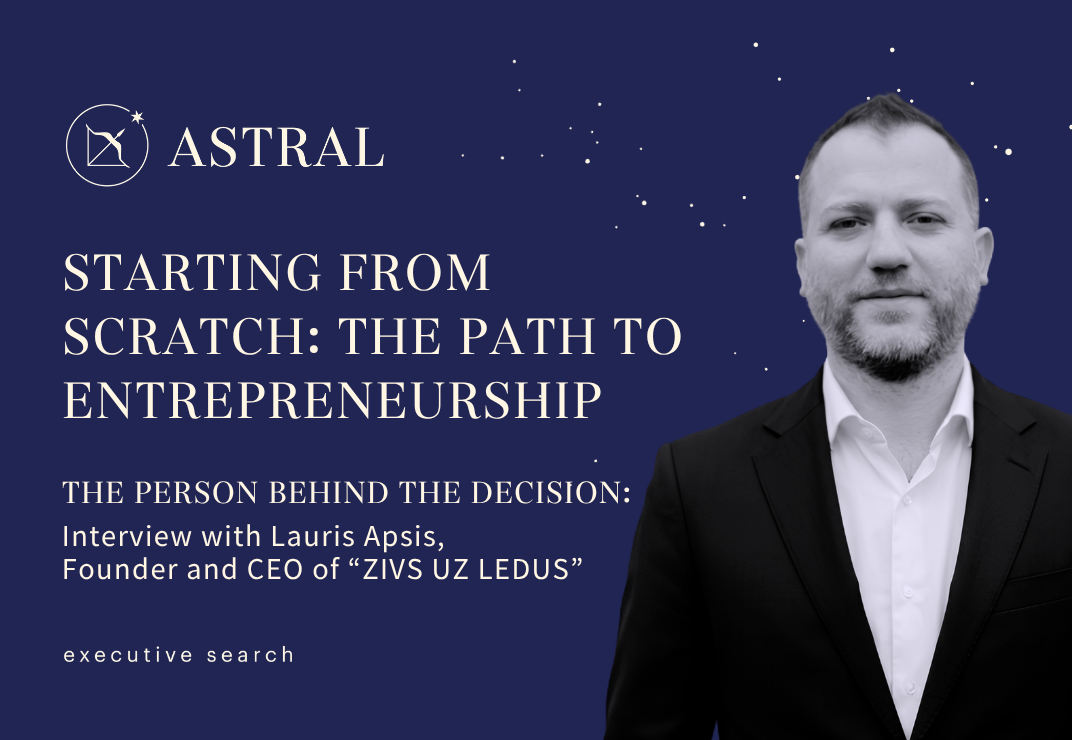
Iluta Gaile, Board Member at ASTRAL Executive Search, met with Lauris Apsis, Founder and CEO of “ZIVS UZ LEDUS”, to discuss his career path, entrepreneurial journey, and the key decisions that have shaped his business.
How would you describe yourself and the organization you currently lead?
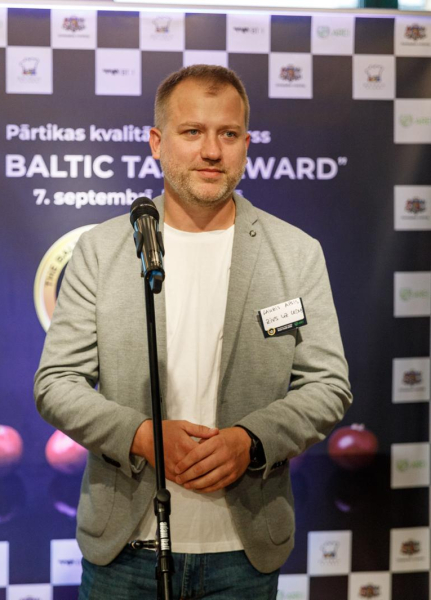
I would describe myself as someone whose defining characteristic is setting very ambitious goals. For me, the feeling of victory in the end result is extremely important. It allows me to maintain an intense level of focus for as long as necessary. When that focus is in place, an entrepreneur can make even the toughest decisions. Crises come and go, and every business has to navigate them. If you can see the distant destination clearly, decisions become easier, more rational, and less emotional. This mindset has helped me build the story of Zivs uz ledus.
We officially launched the company in December 2019, just before the COVID-19 pandemic. Since then, every year has brought new challenges: the pandemic, the war in Ukraine, rising energy costs, and broader economic uncertainty. The second half of 2025 was the first time we truly felt that external pressures were easing and that we were operating in a more stable environment. It has been five years of continuous adaptation and resilience.
Zivs uz ledus is a fish farming company specializing in Arctic char production using closed-loop recirculating aquaculture systems (RAS). I entered this industry quite organically, despite having no prior knowledge of it. However, I had three clear criteria for the type of business I wanted to build.
- It had to be a manufacturing business.
- It had to be export-oriented.
- The business model had to be scalable. If two units work successfully, ten can be built without significant limitations to growth.
I held this vision for many years while working as an employee, until I happened to learn about closed-loop fish farming systems. Today, this is one of the most advanced and sustainable ways to produce fish on an industrial scale while minimizing environmental impact. Ten years ago, there were only a handful of such facilities worldwide. Today, they account for around 5% of global aquaculture production, and projections suggest that figure could exceed 50% within the next 10–15 years. We are at the very beginning of a major growth wave.
Recognizing this potential and seeing how well it aligned with my original criteria, I partnered with Finnish investors to establish a pilot project in Latvia. Today, 70% of the company is owned by our Finnish partners, while I hold the remaining 30%.
What motivated you to leave employment and start your own business? At what point did you realize that you wanted to build something of your own?
There was no single dramatic moment. Leaving a salaried position and taking on the risks of entrepreneurship is challenging for anyone. However, if you see the potential to build something significant and international, it is worth trying. There are never any guarantees, and no company lasts forever. But my desire to try was stronger than my fear of failure.
I have also always had a Plan B or even a Plan C. If things had not worked out, it would simply have meant that this particular business venture had failed. As a professional with entrepreneurial experience, I could always return to an executive role in a salaried position. Would I want to do that today? Probably not.
How would you define a good leader in today’s world?
The definition certainly varies depending on the nature of the business. In my own company, I would say that I am a good leader, although there is always room for improvement.
In manufacturing, the key qualities are strategic vision and a systematic approach. From day one, I have built the company around a simple principle: regardless of which employee performs a task, it should be done according to a unified system. If you completed a task today, I should be able to understand exactly what was done and why, and perform it in exactly the same way tomorrow.
Thanks to this approach, over the past five years we have reduced the number of labor hours required by half. We have gone from eight employees to four. We do not achieve this through overwork, but through efficiency, eliminating unnecessary steps and focusing on doing things smarter.
Has your experience as an entrepreneur changed your definition of what it means to be a leader?
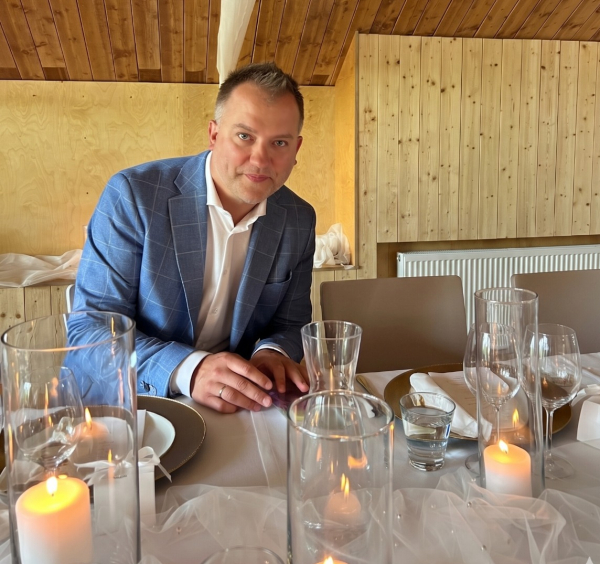
Absolutely. When I was an employee working in telecommunications sales, I often did not see the bigger picture simply because I did not have access to all the information. An employee may believe that certain processes should be improved in a particular way, while a manager evaluates the same situation through the lens of costs, efficiency, and broader business priorities. That is often where disagreements arise.
Today, I realize that I was not always the easiest employee to manage, even though my intentions were good. That experience has given me much greater respect for employees’ suggestions and ideas. I understand where they come from and why they matter.
You entered an industry you had no prior experience in. In the beginning, was it more a calculated risk or a healthy dose of naivety?
“Excel can justify anything. New ideas require a pair of rose-colored glasses; otherwise, we would be too afraid to pursue them.”
It was both. There was certainly a degree of naivety and optimism involved. The initial business plan projections looked phenomenal. At the time, it seemed as though I would only need to come to work two days a week. Reality, of course, turned out to be quite different.
Pragmatism is valuable when you are doing something familiar. But when you are building something entirely new, something for which there are no experts to consult and no university courses to guide you, you have to be willing to take risks without knowing where all the dark corners are.
Without that kind of courageous naivety, we would approach every opportunity too critically and would never make many of the bold decisions that ultimately lead to exceptional outcomes.
What was the most difficult part of transitioning from a salaried position to entrepreneurship: financial uncertainty, full responsibility, or the mental shift?
The mental shift was not particularly difficult for me. I had been developing the business plan and building the company structure alongside my full-time job during my spare time. It was only when the construction phase began that I transitioned fully into the business.
Financial uncertainty was not a major concern either, largely because I was fortunate to have the right partners. We share a similar mindset and understand that in the early stages, results may very well be negative before they become positive.
As for responsibility, I have a special relationship with it. I genuinely enjoy taking responsibility. It seems that nowadays many people are less willing to take ownership of their actions, whereas for me it has always been a source of motivation.
“I take responsibility for every fish that reaches the customer. I want people to know that it is my fish.”
My reputation is one of my greatest assets. It matters to me whether I deliver on my promises and whether people would recommend me as a trustworthy partner. That is why I invest a great deal of time and effort into maintaining my reputation.
Do you remember the moment when you first truly felt, “Yes, this can actually work”?
I would actually turn the question around. The first time I was truly stressed and thought that things might not work out was just two months after we opened the farm, when the COVID-19 pandemic began. We had 40–50 tonnes of Arctic char in our tanks, and suddenly there was no demand for them. However, we mobilized quickly and adapted just as fast.
I also serve in the National Guard. In the military, one of the most important qualities of an officer is the ability to make decisions quickly. Even if a decision turns out to be wrong, it can be adjusted later. The most dangerous thing is hesitation and failing to make a decision at all.
I have believed in this business from day one, and I still do. I once came across a great idea in a book: as long as you are in first place, it does not matter so much who is running behind you. Your job is simply to make sure you stay there.
When you are doing something truly unique on a global scale, success ultimately comes down to execution.
In a way, was not knowing the industry at the beginning actually an advantage?
Absolutely. When I entered the aquaculture industry, I noticed that many people in the sector had historically overlooked areas such as communication, marketing, branding, and direct accountability to the end consumer. Fish farming was largely disconnected from processing, and the end customer often had no idea who had actually raised the fish or whom to thank for the product. I saw this as an outdated approach and believed we could do better.
From day one, I also made a conscious effort to participate actively in international events, conferences, and workshops. If you remain solely within the Latvian bubble, no one in export markets will know who you are. If you are not present, building relationships and engaging with the wider industry, then you can only blame yourself for difficulties in export markets.
What turned out to be completely different in entrepreneurship from what you had originally expected?
When a company is still relatively small, you have to act as an “emulator” for every role within the business. I was not fully prepared for how much time would be spent not on strategy, but on day-to-day operational matters such as recruiting, dismissing employees, negotiating contracts, and handling administration.
However, once these processes are properly structured and running smoothly, they become enjoyable in their own way.
What is the biggest myth about entrepreneurship that you once believed yourself?
In a manufacturing business especially, there is no such thing as weekends, holidays, or fixed working hours – at least not in the early stages.
You have to be willing to step in and do the work yourself, often better than anyone else on the team. During the first two years, I was constantly on-site because I had a very clear vision of the product I wanted to create, and I was personally training the team to achieve it.
Those standards did not appear out of nowhere. I developed them through international experience, industry exhibitions, and conversations with fish farmers from around the world.
What aspect of entrepreneurship turned out to be emotionally much more challenging than you had expected?
Realizing that crises will always be there, and learning not to panic when they happen.
Because we started the business during a crisis, I have become relatively resilient. You cannot be prepared for something you do not know is coming, such as COVID-19, but you can train your overall readiness for uncertainty. If you do nothing, the shock can be devastating.
What from your previous professional experience has helped you the most in your role today?
All of my previous roles have been stepping stones to what I do today. My experience in banking, credit committees, active sales, and building client relationships has become an integral part of my daily work. I draw on those experiences every day, and I genuinely enjoy it.
How does your daily routine today compare to when you were working as an employee?
Life as an entrepreneur is more stressful, but it is a different kind of stress – one that I find more rewarding. I am not bored for a single second.
In a salaried role, stress often comes from limited freedom to act and slow decision-making processes, which can eventually lead to burnout. As an entrepreneur, I can make decisions myself, change direction when necessary, and see the results almost immediately.
Has entrepreneurship changed you as a person?
Yes. My emotional resilience in times of crisis has increased significantly. When it comes to making difficult decisions, I have become more pragmatic and, at times, perhaps even a little more cynical.
If an employee came to you and said, “I want to start my own business,” what advice would you give them?
“Don’t wait. Just do it. Every experience – good or bad – has value.”
If you feel even the slightest desire to start, begin and do not hold yourself back because of fear of making mistakes. To return to the military analogy, it is better to make a quick decision that turns out to be wrong than to spend five years wondering, “What if I had tried?”
While you sit and think about it, the idea simply dies. If you had started five years ago, it might already have evolved into a successful business by now. Progress only begins when you take action.
Is there anything else you would like to add?
I really enjoy bringing together like-minded people from different circles. I encourage every entrepreneur: get out there and talk to others! Not only within your own industry, but also with people from completely different fields. Build connections and share experiences. The challenges we face are often very similar, and the solution may come from where you least expect it. The more open you are, the more opportunities will find you.
Historically, there has been a tendency in Latvia toward a more isolated way of thinking – to build a fence around your business and keep quiet. But Latvia is not small; it is a country with enormous opportunities. We simply enjoy the comfort of our own room. The sooner we step beyond those boundaries, the broader our perspective becomes and the more opportunities of an entirely different scale will open up.
What is the key message you would like to share with others?
Don’t be afraid to take responsibility, and celebrate the small victories!