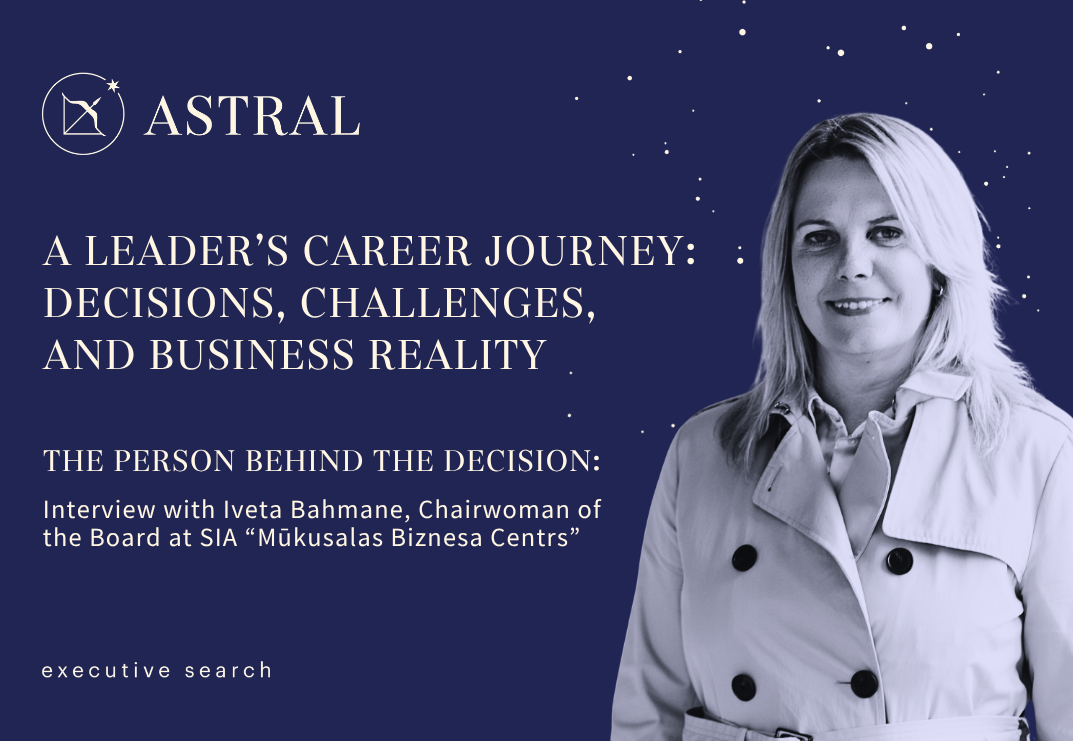
How would you describe yourself and the organization you currently work for?
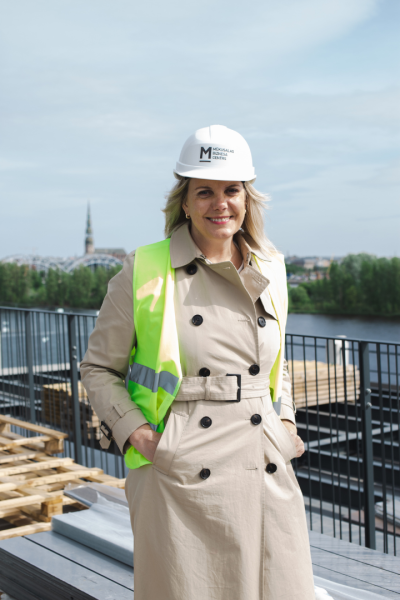
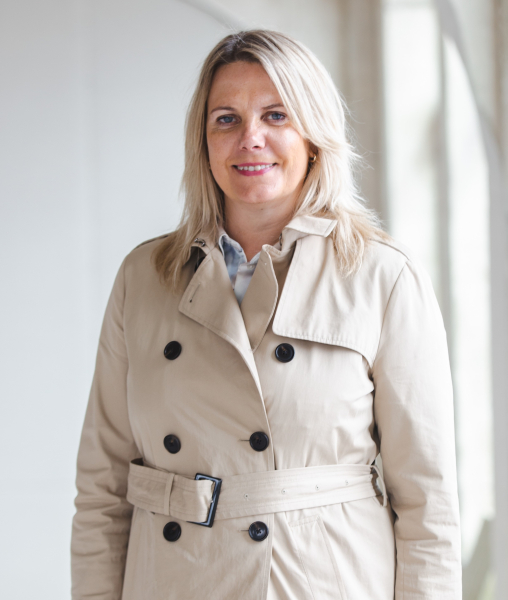
My name is Iveta Bahmane, and I am the Chairwomen of the Board at SIA Mūkusalas Biznesa Centrs. I have been working at the company for seven years. The company is engaged in real estate development and management, primarily in the office and commercial space segment.
Speaking about us as an organization, I would say that these times are quite challenging – and the challenges did not begin only recently. They started back in early 2020 with COVID, followed by fluctuations in electricity prices, then the war in Ukraine, and other factors that created new challenges. That said, both I and the company have navigated this period relatively steadily. I have often reflected on why that is, as we have not been heavily shaken by various disruptions. We have consistently tried to adapt to each situation as it arises. Each time, it feels like this might be the last challenge, but it is usually followed by another.
Currently, there are new challenges as well, such as rising oil prices and potential increases in raw material costs from suppliers. This means we must continuously think about how to adapt and how to plan our costs for the future.
One of the biggest current challenges for the company is significant infrastructure development. This refers to the building at Dēļu iela 4, which has served as a rental property for around 20 years. Theoretically, we could have continued using it as is, but it became clear that without investing in modernization and energy efficiency, the building’s development as an investment asset would stagnate. We made the decision to invest with the goal of improving energy efficiency and reaching higher standards. The total investment amounts to approximately 15 million, which is a very substantial commitment. We have also successfully attracted new tenants to the building, such as Virši-A, MV Distribution Group, and University of Latvia, for which we are developing a new dentistry and optometry training center.
Of course, timing and the market situation are also a challenge. While material prices may be fixed at one point, the situation can change – supply disruptions, price fluctuations, and energy costs can all impact the overall investment volume. This is a risk we actively try to manage.
Overall, despite all these challenges, I can say that we as a company feel stable, as we strive to look ahead and proactively consider what might happen and how to respond. In a way, all of this also characterizes our organization – how multi-layered and dynamic it is.
“What motivated you to move toward a leadership role? At what point did you realize that you wanted to take on a leadership position?
I have been writing a journal for a long time – not in the traditional sense, like noting what time I woke up or what I did, but more about how I feel, what I want, and what challenges I am facing at the time. I write them down, and through that process, I somehow manage to work through them.
Not long ago, I noticed that at the age of 36, I had written in my journal that I wanted to independently lead a company. It was quite vague, but at the same time, this desire eventually materialized. Why did I want that? I am absolutely convinced that the main reason is that I find it difficult to work in a company or a unit where I don’t truly trust the manager. If a leader is not strong enough in their role, is not a clear leader, cannot stand by their decisions, or gives in to external pressures, it is very hard for me to accept that.
At that point, I made the decision that I wanted to lead myself, make decisions, and not report to anyone. Of course, in reality, it is not that simple – I also have shareholders in my company to whom I am accountable. However, there is mutual respect here for what they have built and how they run their business. At the same time, I am given a significant degree of freedom to make independent decisions, and that is very important to me.
I also find it difficult to work in a routine. Regular meetings with the same people discussing the same issues over a long period do not suit me. After just a few such meetings, it becomes exhausting. And it is the responsibility of a leader to ensure that meetings do not become like that. That is why it is important for me that the work remains dynamic and that processes are organized in a way that prevents stagnation.
How would you define a good leader today? Has this definition changed over the past 10 years?
This question can be approached from two perspectives. One is generational differences—leaders from the older generation, such as my parents or people over fifty, in my view differ from younger-generation leaders, who are roughly between thirty and fifty.
I have not personally worked under a younger leader, so this is more of my assumption. It seems to me that younger leaders may have greater ambitions and a stronger desire to globalize processes regardless of the industry. At the same time, I feel that the human factor might be somewhat less important to them, although that is my interpretation.
Speaking about my own generation, the human aspect is still very important to us. For example, remote work is not something I personally relate to, and I don’t see how work can be fully effective without meeting people in person. Presence matters to me—people, energy, and live communication. I think younger-generation leaders may view this differently, but that is my subjective perspective.
Looking back on your career path, how would you describe your professional development up to today?
I would say that my professionalism has grown alongside the industries I have worked in. I spent more than a decade in the banking sector, then worked at Tet (formerly Lattelecom), and later moved into a completely different field – real estate development. In each of these industries, I have developed in the areas I was responsible for.
I would encourage everyone not to be afraid of changing industries, as it only brings benefits. It can be compared to completing another university degree. If studying at university takes three years, then in practice this process can take even longer – and in essence, you are continuously learning.
Even now, I continue to learn – both about construction and financing matters. For example, if SIA Mūkusalas Biznesa Centrs goes through an IPO process, that will be yet another area where new knowledge and practical experience will be required.
In your career, you transitioned from large organizations such as Tet and SEB banka to a more dynamic environment at SIA Mūkusalas Biznesa Centrs—what motivated you to make this decision?
It happened quite naturally. I was on maternity leave and realized that I couldn’t just stay at home. I started keeping myself occupied – developing an interest in art. I visited museums, tried to learn about paintings, and memorized who had created them. At home, I would test myself, trying to recall the artists without any notes. That’s how I kept myself engaged on a daily basis.
At that time, Klāvs Vasks, who is now a co-owner of SIA Mūkusalas Biznesa Centrs, asked me what I was doing. I said that I wasn’t doing anything specific at the moment. In fact, I wasn’t actively looking for anything – I was simply waiting to see what would come next. And then the opportunity came.
Of course, at first I was afraid. I thought – how will I be able to work in an industry I know nothing about? But despite those fears, I accepted the challenge. In the end, everything turned out to be much easier than it initially seemed.
What was the biggest surprise for you when you transitioned into the real estate development industry more than seven years ago?
“In your opinion, how will the real estate industry develop in Latvia and Riga over the next five years? Will there be any significant changes?
The answer to this question can be divided into two parts. One is the residential segment and its development, and the other is the office and industrial segment, which includes warehouses, large logistics centers, and office buildings.
Looking at the office segment, over the past two years, almost no new buildings have been commissioned compared to, for example, 2023. Currently, several projects are under development, including Verde and projects on Hanzas Street, as well as our own office building reconstruction at Dēļu iela 4. Of course, we are not the only ones developing office projects at the moment. Overall, this indicates that demand for office space is being met gradually rather than through the rapid development of a large number of new buildings at once.
In contrast, the residential segment shows significantly higher activity. At present, many projects are being developed, both large and small. For example, in the Āgenskalns neighborhood, around Māras Pond alone, several large apartment developments can be identified. This indicates a return of demand and the ability of residents to purchase housing. It may also reflect a shift from older housing stock to newer, more modern projects.
Another important direction is the development and strengthening of neighborhoods. In our case, within the territory of SIA Mūkusalas Biznesa Centrs, we have made a decision to actively shape and develop this area. It is becoming increasingly significant due to its proximity to University of Latvia, student dormitories on Jelgavas Street, the development of new residential projects, and planned mobility points, which are an important initiative of the Riga City Council.
In this context, neighborhood development becomes a shared responsibility. By creating local initiatives, it is possible to join forces and represent common interests, cooperating with the municipality and participating in development processes. A good example is the Kīleveina Canal, which separates Jelgavas Street from our territory. It is currently in poor condition and requires improvement. This requires involvement from both the city and the local community. It cannot be done by one or two developers alone – the entire neighborhood needs to be aligned in order to achieve meaningful results.
In addition, it is important to think about broader solutions, such as jointly developing infrastructure, mobility projects, and the overall environment. There are many ideas, and their implementation largely depends on initiative and cooperation. For this reason, SIA Mūkusalas Biznesa Centrs has launched a neighborhood development initiative. Anyone connected to this area is encouraged to get involved and contribute to its development.
When working on development projects at SIA Mūkusalas Biznesa Centrs, where do the biggest challenges most often arise?
The main challenge is construction. Ideally, a developer, as the client, signs a contract, finances the project, and expects the result. In reality, however, the process is much more complex. The client signs an agreement with a general contractor, who in turn works with multiple subcontractors. Within this chain, problems often arise. A subcontractor may lack financial resources, workforce, or face other difficulties. These issues gradually move up the chain to the general contractor and ultimately reach the client.
As a result, the client often has to become directly involved in the construction process to resolve these matters. This can mean engaging even at the subcontractor level, looking for solutions, contributing ideas, or sometimes even providing resources. For this reason, we hired a construction project manager, who, incidentally, is a woman and represents our interests as the client. Previously, this was not necessary, but given the growing complexity of projects, it has become essential. Such a specialist can professionally assess situations and identify issues, preventing unfounded arguments from the construction side. If the client does not get involved, the risk is very high, and the outcome may not be favorable for either side.
Unlike residential developers, in the office and commercial segment there are often pre-signed agreements with tenants, committing to specific deadlines for when premises will be available. If construction is delayed, this creates direct pressure and can lead to complicated situations in relationships with tenants. To avoid this, we actively engage in the construction process and try to resolve problems as quickly as possible, sometimes even taking on part of the subcontractors’ challenges. However, there are situations that cannot be resolved, for example, when a subcontractor lacks workforce. In such cases, alternative solutions must be found, including changing partners.
Overall, construction is currently one of the biggest challenges for developers. In our case, the specific project must be completed by September 2026, and as is often the case, the final stage is the most challenging.
What does the reality behind large construction and development projects look like—what are the things people on the outside don’t see?
In a way, it’s actually good that you don’t see how complex the construction process really is. It is a constant struggle, with long meetings involving contractors and subcontractors that can last for hours and often feel like an inefficient use of time. If every link in the chain completed its work on time and in line with agreed deadlines and budgets, such situations would not arise.
In reality, however, problems often start at the subcontractor level. There may be an inability to manage their business properly, or a lack of workforce, financial resources, or materials. This affects the entire chain and the overall outcome. It is not only critical for a specific project but also reflects broader economic realities. Each link in the chain must be able to fulfill its obligations for the system to function.
The construction industry clearly highlights how important it is to adhere to commitments and contractual terms, including deadlines, costs, and quality standards. Unfortunately, in practice, this is not always the case, and that is where the biggest challenges arise.
What is more difficult in a leadership role - making decisions or working with people? Why?
Probably the most difficult part is working with people. First of all, team selection—finding people who share the same value system. That is how I see it. The strongest teams are built when people’s values align. It is not so much about qualities like diligence, but about what truly matters to a person—why they work and what motivates them.
In our team, for example, family is a very important value. For each individual, it matters, and as a result, we are aligned on the same value scale. This also creates a very family-like internal culture within the company.
Of course, building such a team takes time. However, once the team is in place, the work becomes easier because there is less unnecessary tension. For instance, if someone’s priority were constant travel and a completely different lifestyle, they would most likely not fit into such a team. For us, presence, focus, and the ability to work on practical matters are important.
Managing people becomes especially difficult in situations where problems need to be resolved—when agreements must be reached, alignment achieved, and those agreements consistently upheld. If that does not happen, you have to return to the same issues repeatedly, which requires a lot of energy. There are also situations where, despite all efforts, it is not possible to find common ground. I have experienced this myself, and it is a difficult moment—to accept that not everything can be resolved. In such cases, the only solution is to seek support or involve a third party, such as mediation, or to delegate the issue to someone else. In my view, this is one of the most challenging aspects of a leadership role.
Can you share a situation where you had to make an unpopular or difficult decision? How did you handle it?
One of the most difficult periods in my experience was the time following the 2009 financial crisis in Latvia. At that time, banks had overfinanced many clients, including in the leasing sector. I was leading the leasing function then, and the situation was extremely complex. We had to make decisions regarding many assets—leased vehicles that had to be repossessed and then sold. This process in itself was challenging, as sales were often made at a loss and there was very limited demand for these assets. At the same time, the bank made a strategic decision to reduce the number of employees, as it was clear that business volumes would not return to previous levels.
In my team, I had to make the decision to let go of around fifteen people. Most of them were women, including some who were on maternity leave. This made the situation even more difficult from a human perspective.
These conversations were extremely hard. People came with their personal stories, their families, and children, which made the process emotionally very demanding. At the same time, from the company’s perspective, it was clear that there was no alternative—the positions simply no longer existed, and business volumes had significantly declined. In such moments, a leader must be able to make very difficult decisions. It is a complex balance between the human and the professional side. This was definitely one of the most challenging periods in my career.
Even now, at SIA Mūkusalas Biznesa Centrs, it is not the case that we never let people go—we do, but mostly in situations where employees do not deliver results. In smaller organizations, this is very visible. It is clear whether a person is working effectively or not. There is no opportunity to “hide” behind structures or processes. You can often see within a short period of time, even within a week, whether someone has completed their work. Therefore, decisions to terminate employment are usually related to a lack of results, delays in work, or insufficient engagement.
In your opinion, what mistakes do leaders most often make when working with people?
What is the biggest myth about a leader’s role that you have encountered?
The biggest myth is that a leader does not really have to do anything – that they simply assign tasks and do not actually work themselves. That they attend meetings, participate in various events, but do not do any real work. In my view, the best leaders are never disconnected from day-to-day processes. They do not go into every small detail, but they have a clear overview of what is happening in the company. At the same time, they never rely entirely on others without understanding things themselves.
There are many examples where leaders rely too much on their teams and lose control, which can put the company in a difficult position. Trusting the team is important, but it is equally important to stay involved and understand what is going on. Through their work, interest, and attitude, a leader must show that they care about the company and its development. It is not only about results or profit – it is about involvement and responsibility.
Where do you think this myth about the role of a leader comes from?
I would say that this perception largely comes from childhood. My father used to be the head of a large agricultural enterprise – he had a Volga, his own office, a big desk, and a telephone on it. As a child, this seemed impressive to me, and my brother once said he would like to be like our father – just drive a car and talk on the phone. Of course, today it seems a bit amusing, but such impressions stay somewhere in the subconscious. It creates the sense that a leader “doesn’t really have to do anything,” that their role is simply to “manage people.” In reality, however, working with people is the most complex part. It is not simple – it is the most demanding and responsible aspect of a leader’s role. So, in a way, this myth may stem from earlier times, when the role of a leader appeared very different from the outside than it actually is in reality.
If you could go back to the beginning of your career, what advice would you give yourself?
If I had to give myself one piece of advice, it would be to be more courageous. Although from the outside it may seem that I am confident, and humor certainly helps, there are also moments of vulnerability, and that is completely normal. I have observed that entrepreneurs often act first and then think. Of course, with a reasonable approach, but still – action tends to come first for many of them. In my case, I am more inclined to analyze everything, assess risks, think it through again and again, and only then act. That is why I would wish for myself more courage, both at the beginning of my career and going forward as well.
As a woman, do you see any advantages in working in a leadership role within the real estate industry?
I often see myself as being in a kind of “one-person performance.” In situations where a result needs to be achieved, I am willing to try very different approaches. I can be very emotional, strict, demanding, or humane – I adapt to the situation and to the people I work with. It seems to me that men do not position themselves in the same way. Sometimes this means stepping outside the usual framework and experimenting with different approaches to understand what works in a particular situation. Not everything succeeds, and often the people on the other side are highly experienced and not easy to influence. At the same time, I see that this flexibility and ability to adapt helps me. Perhaps this is also characteristic of women – to be a bit unpredictable, which can sometimes be an advantage. Overall, I do everything I can to achieve the result. That is my approach and also my motivation – not to stop and to keep looking for solutions until the goal is reached.
Is there anything else you would like to add?
I have also thought about this in relation to my child and upbringing – how to raise responsible people who see work as an important value and understand the broader meaning of development. This strongly connects with what I mentioned earlier about subcontractors and entrepreneurs in general. Often, the issue is the inability to take responsibility for one’s decisions and commitments.
In my view, an important question is why people often lack this sense of responsibility in everyday life. Why are they afraid to take responsibility for their work and their word? How can this be taught? Does it come from family, education, or experience?
It is important to understand that mistakes are a natural part of the process. You will make mistakes, you will not always complete everything perfectly, but that does not mean there will immediately be negative consequences. It is precisely through experience and practice that we learn and become stronger. If everyone fulfilled what is expected of them or what they have promised to others, and were not afraid to take responsibility, the economy as a whole would be much stronger and more developed.
At the moment, what is often lacking is the willingness to see things through to the end. How can this be changed? In my opinion, education plays a major role. It starts at school. Children should be taught what entrepreneurship is and how it actually works. Often, schools teach that you will go to work and receive a salary, but much less is said about what it means to create work yourself and earn money independently. What it means to take risks, how a company is built, what is required to establish it, and how to manage people.
If this understanding were developed from an early age, attitudes toward work, responsibility, and results might also be different. Once a person understands these basics, a logical connection begins to form – how money is created, how it flows, and why taxes need to be paid. It seems that even today, some people do not fully understand the role of taxes.
There needs to be an understanding that taxes are not just an obligation, but are directly linked to the needs of society. Without taxes, the question arises – how would all shared services and public goods be provided? This is an understanding of the system as a whole, which only develops when a person grasps the fundamentals and sees this connection in practice. Everything starts with education.